
Autoclave Pressurization Systems: Selecting the Right Solution According to Process Requirements
Autoclaves are industrial equipment manufactured in accordance with pressure vessel standards, designed to operate under controlled temperature and pressure conditions. In the simplest terms, they can be considered specialized ovens operating under high pressure. However, one of the most critical factors determining an autoclave's performance is the method used to generate the internal pressure.
Autoclaves used across different industries require different pressurization systems depending on process requirements. In general, autoclave pressurization methods can be classified into two main categories:
- Pressurization with saturated steam
- Pressurization with gases or liquids
Pressurization with Saturated Steam
One of the most common methods used in autoclaves is pressurization with saturated steam. In this system, saturated steam generated by steam boilers is transferred into the autoclave with minimal energy loss, directly pressurizing the process chamber.
One significant advantage of saturated steam is that it provides heat transfer while simultaneously generating pressure. Under saturated steam conditions, pressure and temperature are directly related. Therefore, both pressure and temperature can be achieved without requiring an additional heat transfer medium.
This method is particularly preferred in applications such as:
- AAC (Autoclaved Aerated Concrete) autoclaves
- Wood impregnation autoclaves
- Sterilization autoclaves
- Most rubber vulcanization autoclaves
Another advantage of saturated steam is its ability to distribute naturally and uniformly within a cylindrical pressure vessel. As a result, additional circulation fans are generally unnecessary, allowing similar process conditions to be maintained throughout the entire autoclave.
Gas Pressurization Systems
In some processes, the use of steam is not suitable. In such cases, pressurization is achieved using gases such as compressed air, nitrogen, argon, helium, or carbon dioxide.
Typical applications include:
- Glass lamination autoclaves
- Composite curing autoclaves
- Ballistic autoclaves
- Certain rubber vulcanization processes
Gas-pressurized systems introduce an important difference. The heat transfer provided by the natural convection of gases is generally insufficient to achieve the temperature uniformity required in most industrial processes. Therefore, forced circulation fans are used.
The key distinction lies in the heat transfer mechanism: saturated steam delivers extremely high latent heat through condensation, whereas air transfers only sensible heat. Consequently, autoclaves designed for gas pressurization are equipped with circulation fans and fan motors capable of operating under high-pressure conditions. These continuously circulate the heated gas generated by the heating system, ensuring uniform temperature distribution throughout the autoclave.
The choice of pressurizing gas depends entirely on the process requirements. For example, in glass lamination processes, operating temperatures are typically around 160°C with pressures of approximately 13 bar, making compressed air an economical and sufficient solution.
In contrast, nitrogen is generally preferred for thermoplastic composite curing applications that require both high temperatures and high pressures. The primary reason for using nitrogen is to reduce the oxygen concentration inside the chamber, thereby minimizing the risks of fire and oxidation.
Depending on the specific process requirements, other gases such as carbon dioxide, argon, or helium may also be used.
Liquid Pressurization Systems
As pressure levels increase, the energy required to compress gases and the associated storage infrastructure become significantly larger. Beyond a certain point, liquid pressurization can provide a more economical solution.
These systems are particularly used for thick composite components and certain ballistic applications, where autoclaves are generally designed in a vertical configuration. Before pressurization, all air inside the pressure vessel is removed, and the vessel is completely filled with water or another process-compatible liquid.
Since liquids are generally considered practically incompressible in engineering calculations, introducing additional liquid into the closed vessel enables extremely high pressures to be achieved. Compared with gas-based systems, this method allows much higher pressure levels to be reached safely.
Operating Principles of Pressurization Systems
Direct Steam Pressurization
In these systems, saturated steam supplied directly from a steam boiler is used for pressurization. Steam boilers may be powered by electricity, natural gas, thermal oil, or liquid fuels.
Compressed Air Pressurization
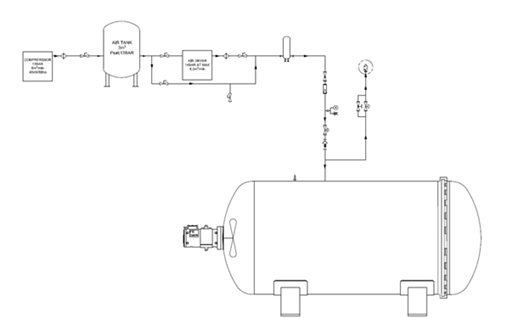
A typical compressed air system consists of:
- Air compressor
- Air dryer
- Filtration equipment
- Piping system
- Buffer tanks
In these systems, the pressurization ramp—that is, the rate at which pressure increases or decreases per minute—is critically important and must be carefully selected according to the process requirements. Depending on the curing, lamination, or vulcanization process, this ramp is typically between 0.2 bar/min and 0.5 bar/min.
All equipment and piping within the system are designed and manufactured to meet the specified pressurization ramp.
For applications requiring higher pressures, compressed air is boosted to 40 bar, 100 bar, or even 300 bar using booster compressors and stored in high-pressure storage vessels. The autoclave then receives its compressed air supply from these storage tanks.
Pressurization with Nitrogen and Other Gases
There are three primary approaches to gas pressurization systems.
The first method involves the direct use of gas stored in high-pressure cylinders. This approach is highly practical for facilities with relatively low gas consumption.
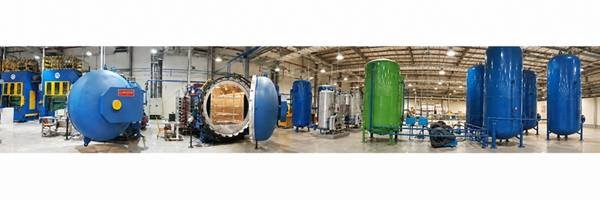
The second method is on-site gas generation using gas generators. For example, in nitrogen generators, compressed air passes through specialized filtration systems where nitrogen is separated while the remaining gases are discharged. If the generated nitrogen is already at sufficient pressure, it is supplied directly to the autoclave. Otherwise, booster compressors increase its pressure before transferring it to high-pressure storage vessels.
The third method utilizes liquefied gases. Cryogenic fluids such as liquid nitrogen or liquid carbon dioxide are vaporized in a controlled manner, producing an enormous increase in volume. For example, liquid nitrogen at approximately −196°C expands to nearly 700 times its liquid volume when converted to the gaseous phase. This characteristic is advantageous for both generating high pressure and providing an inert atmosphere.
Liquid Pressurization
In liquid pressurization systems using water, oil, or similar fluids, all gas inside the vessel is first removed, and the chamber is completely filled with liquid. High-pressure pumps then introduce additional liquid into the closed system. Because liquids are essentially incompressible, extremely high pressure levels can be achieved.
Conclusion
The pressurization system used in an autoclave is determined entirely by the specific process requirements. Saturated steam, compressed air, nitrogen and other process gases, as well as liquid pressurization systems, each address different requirements in terms of temperature, pressure, safety, and product quality.
Therefore, when planning a new autoclave investment, selecting the appropriate pressurization technology should not be based solely on the target pressure. Process temperature, product characteristics, safety requirements, operating costs, and energy consumption must also be carefully evaluated to determine the most suitable solution.
