
Comparison of Pre-Shredding and Post-Shredding Systems in Medical Waste Sterilization Systems
The safe disposal of medical waste is critically important for environmental and public health. Today, many healthcare institutions prefer to render infectious waste harmless through sterilization technologies. Autoclave-based medical waste sterilization systems generally have two different design approaches: pre-shredding systems and post-shredding systems.
While both systems enable safe disposal by sterilizing waste, they differ significantly in terms of operating principle, capacity, maintenance requirements, and facility layout.
Sterilization Process and Technical Parameters
In medical waste sterilization, the process is generally performed using saturated steam. For both pre-shredding and post-shredding systems, typical process parameters vary within the following ranges:
- Sterilization temperature: Generally 134-150 °C
- Pressure: Approximately 3-5 bar(g), depending on the temperature level
- Sterilization holding time: Generally 10-30 minutes, depending on the process temperature
- Sterilization effectiveness: Verified by the F0 value
F0 Value and Microbiological Validation
The F0 value is a time-temperature-based validation parameter that expresses the microbiological killing effect of the sterilization process. It is used to evaluate process performance, especially in sterilization processes requiring high reliability.
The targeted microbiological inactivation levels in medical waste sterilization systems are generally 6Log10 and 8Log10.
Sterilization performance should be verified not only through temperature and pressure values, but also through biological indicator tests, chemical indicators, and validation reports.
Depending on the relevant application, EN 285, ISO 13485, and applicable international standards are referenced in the system design.
Pre-Shredding Systems
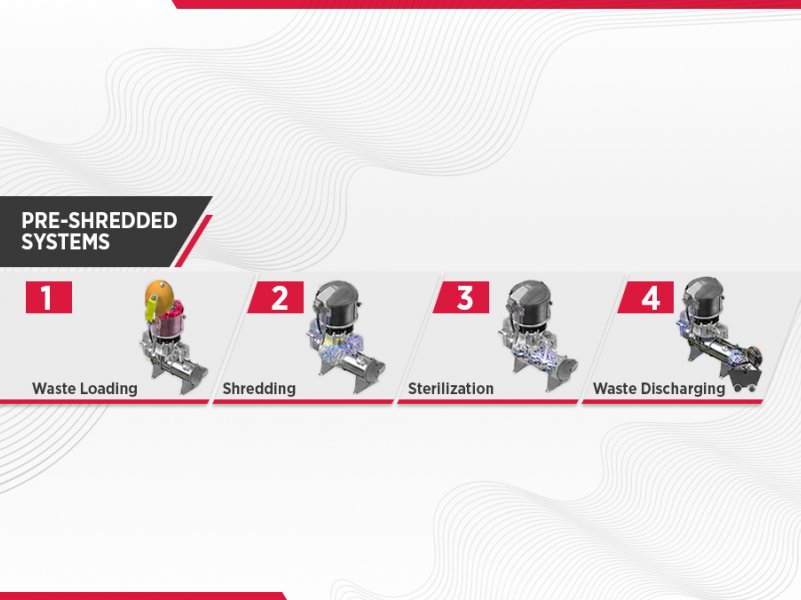
In pre-shredding systems, medical waste is first passed through a shredder and reduced in size, and is then transferred into the autoclave for the sterilization process. The shredder and autoclave generally operate as an integrated compact system.
Advantages
- Compact Design; One of the most important advantages of pre-shredding systems is that they require a small installation area. Since the shredder and autoclave are combined in a single unit, the overall footprint of the system is quite small.
- Suitability for In-Hospital Use; It is an ideal solution for hospitals, clinics, and healthcare centers with limited space. It can be easily integrated into existing facilities.
- Lower Initial Investment Cost; Since they are designed for smaller capacities, investment costs are generally lower than those of centralized systems.
- Sterilization Effect; The fundamental technical approach of systems that perform pre-shredding is that reducing waste size improves the sterilization process.
- Smaller Waste Size; Through shredding, waste pieces are reduced in size, the steam contact surface increases, and more homogeneous heat transfer can be achieved.
- Improved Steam Penetration; Steam circulation may become easier within reduced waste particles. This helps increase sterilization effectiveness, especially in dense and heterogeneous waste structures.
Disadvantages
- Limited Processing Capacity; These systems are generally designed for low to medium daily waste quantities. They may be insufficient in terms of efficiency at facilities with high waste volumes.
- More Complex Integration; Because the shredder and autoclave operate in an integrated manner within the same system, mechanical and operational complexity is higher. A failure in any equipment may cause the entire system to stop.
- Maintenance and Service Difficulties; The interconnection between the shredder and the sterilization unit may make maintenance operations more difficult. In some cases, the entire system may need to be taken out of service for maintenance.
- Cleaning Difficulties; Waste adheres to the shredder and autoclave walls, making equipment cleaning more difficult. Cleaning must be performed with operator intervention.
Post-Shredding Systems
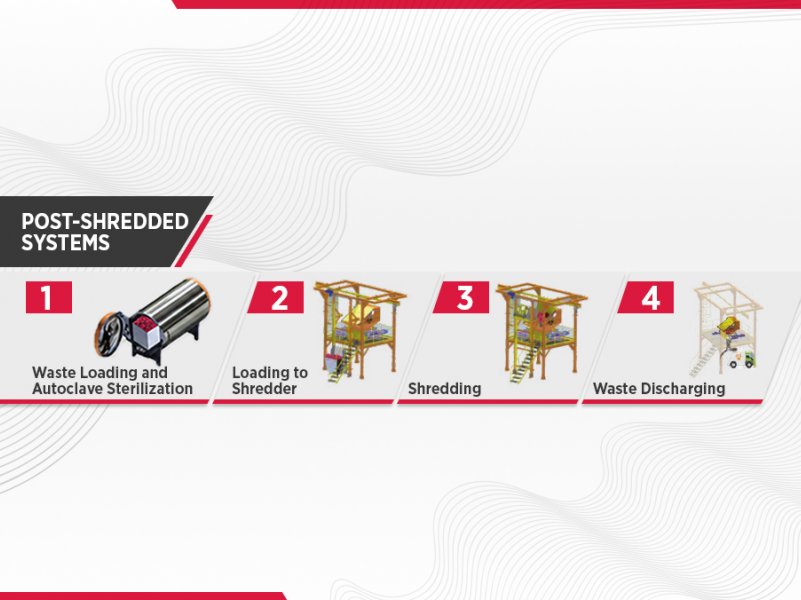
In post-shredding systems, medical waste is first sterilized inside the autoclave and is then transferred to a separate shredder unit, where it is physically reduced in size. The shredder and autoclave are designed as independent pieces of equipment.
Advantages
- Sterilization of Infected Waste First; Infected waste is first made safe in a closed sterilization environment, preventing mechanical equipment from operating under a high biological load.
- High Processing Capacity; Post-shredding systems are developed for large-volume waste flows. Thanks to larger autoclave volumes and optimized process designs, high daily capacities can be achieved.
- Easier Maintenance and Service; Since the autoclave and shredder are independent pieces of equipment, maintenance work can be performed more easily. Service work on one piece of equipment does not directly affect maintenance of the other.
- Higher System Reliability; Since the mechanical equipment is separate, failure management is easier. This is an important advantage, especially in facilities where uninterrupted operation is critical.
- Lower-Risk Operation of the Shredder; Since the shredder operates with lower biological risk after sterilization, operational safety increases and the shredder does not need to be sterilized.
- Suitability for Capacity Expansion; In projects where future capacity increases are planned, their modular structure can offer more flexible solutions.
Disadvantages
- Larger Space Requirement; Due to the separate autoclave, transfer equipment, and shredder unit, a larger installation area is required.
- Higher Investment Cost; Due to large-capacity equipment and additional conveying systems, the initial investment cost is generally higher.
- Larger Waste Size; In order to shred a higher amount of waste in a shorter time, larger blades are used, and the resulting waste size is larger.
Energy Consumption and Operating Cost
When evaluating a sterilization system, the initial purchase cost alone should not be considered. In technical investment decisions, a life cycle cost (LCC) assessment should be performed in order to reveal the long-term performance and total operating expenses of the system. Within this scope, energy consumption, consumables, maintenance requirements, and operational costs should be analyzed together.
When assessing energy consumption, kWh/ton energy consumption, the power ratings of the motors used, and the efficiency of the heating system should be taken into account. Systems that provide more efficient heat transfer and have optimized process control can deliver lower energy consumption in the long term.
Steam consumption is one of the main cost items, especially in steam sterilization processes. When evaluating system performance, the amount of steam consumed per ton (kg steam/ton waste), the efficiency of the steam generation system or boiler, and heat recovery solutions applied where possible should be considered. Optimizing steam consumption both reduces operating costs and increases energy efficiency.
Water consumption is also an important factor to consider in system design. The amount of water used, particularly during vacuum systems and condensate management, can directly affect operating costs. Therefore, low-water-consumption and efficient process designs should be preferred.
Spare parts and maintenance expenses also play an important role in long-term operating costs. In particular, the maintenance intervals and replacement costs of components such as shredder blades, mechanical moving parts, seals, valves, and steam equipment affect the overall operating economy. Therefore, when determining the real cost of a sterilization system, not only the purchase price but also the total cost (LCC) generated over the entire service life of the equipment should be taken into account.
Comparison Table
|
Criterion |
Pre-Shredding System |
Post-Shredding System |
|
Process sequence |
Shredding → Sterilization |
Sterilization → Shredding |
|
Space requirement |
Low |
High |
|
Capacity |
Low-Medium |
Medium-High |
|
Steam penetration |
Advantageous due to reduced waste size |
No shredding before sterilization |
|
Mechanical contact with infected waste |
More |
Less |
|
Ease of maintenance |
More difficult |
Easier |
|
Effect of failure |
May affect the entire system |
More localized intervention is possible |
|
Typical use |
Hospitals and clinics |
Collection centers and centralized facilities |
Pre-shredding and post-shredding medical waste sterilization systems offer solutions for different needs. For healthcare institutions that operate in small areas and generate relatively low amounts of waste, pre-shredding systems provide an economical and compact solution, while for regional waste processing facilities requiring high capacity, post-shredding systems become a more suitable option.
When selecting the system, daily waste quantity, facility area, maintenance strategies, expectations for operational continuity, and future capacity expansion plans should be evaluated together. The correctly selected system will both optimize operating costs and ensure the safe disposal of medical waste.
