
The Akarmak Difference in Autoclave Energy Efficiency
The Akarmak Difference in Autoclave Energy Efficiency
Industrial autoclaves play a central role in many manufacturing processes, including composite curing, glass lamination, rubber vulcanization, tire retreading, building material production, and sterilization. Since these processes require high-temperature and high-pressure conditions, energy consumption represents a significant operating cost for businesses.
However, the energy efficiency of an autoclave does not depend solely on the heating system used. The entire system must be evaluated as a whole, from the autoclave’s dimensions and insulation to air circulation, automation systems, and the selection of auxiliary equipment.
With an engineering approach tailored to each project, complete autoclave systems are designed not only to meet process requirements, but also to use energy in the right place and in the right amount.
An Efficient Start Through Proper Sizing
Energy efficiency begins at the autoclave design stage. An autoclave selected larger than required for the actual production need causes an unnecessary volume to be heated and pressurized during every cycle. This results in longer cycle times, higher energy consumption, and increased operating costs.
For each project, product dimensions, production capacity, loading configuration, and target cycle times are analyzed. Based on this information, the most suitable autoclave dimensions are determined for the process. This enables businesses to improve production efficiency by using only the amount of energy they actually need.
For more detailed information about the criteria that should be considered when determining autoclave dimensions, you can read our article titled “What should be considered when determining autoclave dimensions?”
Insulation That Reduces Heat Loss
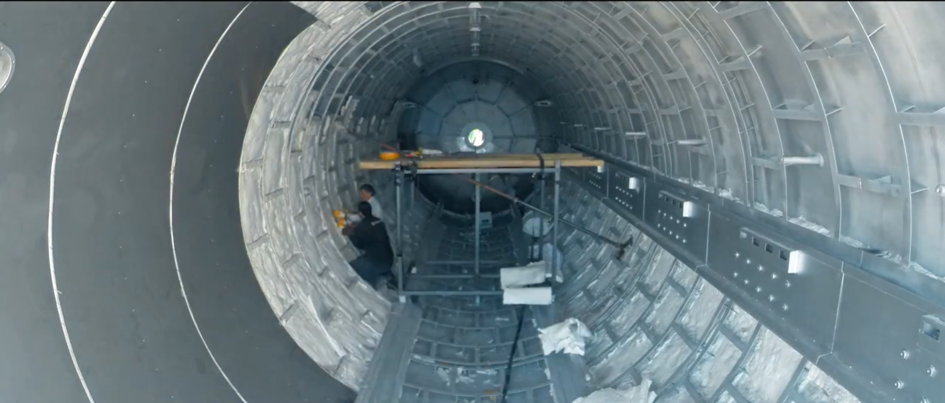
Maintaining the temperature generated inside the autoclave directly affects the system’s energy performance. Insufficient insulation causes heat to escape into the surrounding environment and forces the heating system to operate more intensively.
In Akarmak autoclaves, insulation materials and thicknesses suitable for the process temperature are selected with the aim of reducing heat loss. This allows the target process temperature to be maintained more consistently while preventing unnecessary energy consumption.
Effective insulation does more than save energy. It also contributes to a more uniform temperature distribution inside the autoclave, better process control, and a safer working environment.
Variable-Frequency Fan Systems
Air circulation inside the autoclave ensures that heat reaches all products evenly. However, it is not always necessary for the fans to operate at the same speed during every stage of the process.
Thanks to the variable-frequency fan motors used in Akarmak autoclaves, fan speed can be adjusted according to process requirements. The airflow needed during heating, holding, and cooling stages differs. Operating the fans only at the required level helps optimize energy consumption.
This system also reduces the load on motors and mechanical components, contributing positively to equipment service life and maintenance performance.
For more detailed information about the advantages of variable-frequency fan motors in autoclave systems, you can read our article titled “Why Do We Use 'Fan Motors with Frequency Control' in Our Autoclaves?”
Uniform Temperature Distribution
For an autoclave to be energy efficient, low energy consumption alone is not enough. The energy used must also be transferred to the products correctly and evenly.
The formation of hot and cold spots inside the autoclave may prevent some products from reaching the target temperature. In such cases, the cycle may need to be extended or the production process repeated. This results in both time and energy losses.
The fan design, air ducts, heating system, and loading area are evaluated together to achieve optimum air circulation. Uniform temperature distribution helps maintain product quality, keep process times under control, and reduce the need for rework.
Efficient Energy Use Through Precise Power Control
In electric heating systems, the method used to control the heating elements has a significant impact on autoclave temperature stability and energy performance. In traditional contactor-based systems, heaters are switched on and off in predefined stages, while thyristor-controlled systems allow the power supplied to the heating elements to be adjusted more precisely according to process requirements.
Thyristors can switch rapidly without mechanical wear. Particularly when approaching the target temperature, they continuously modulate the power output, allowing the system to reach the desired temperature in a controlled manner. This reduces temperature fluctuations and overshooting while providing a more stable and repeatable process.
Akarmak determines the system configuration according to the autoclave capacity, heating power, and process requirements, and can implement either contactor-based or thyristor-controlled solutions. The objective is to deliver the required heating power at the right time and in the right amount, thereby optimizing temperature control, process stability, and energy use.
Advanced Automation and Process Control
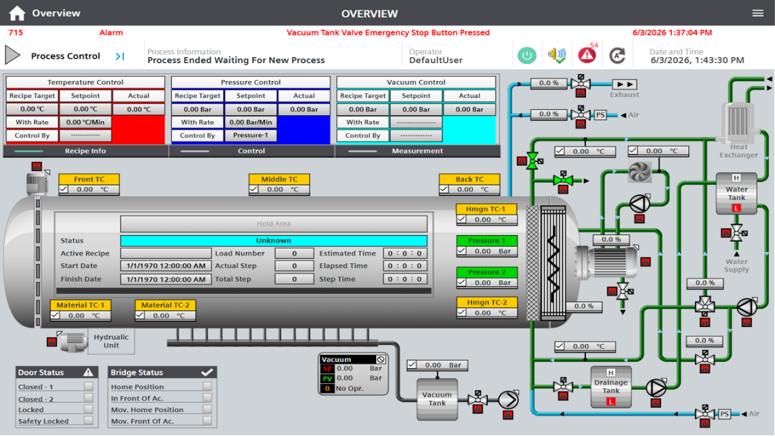
Automation systems play an important role in energy efficiency. Precise control of parameters such as temperature, pressure, fan speed, vacuum level, and cycle duration ensures that the system uses only the amount of energy required.
Thanks to our advanced control systems, operators can monitor every stage of the process in real time. Recipes created for different products can be saved, and the same process can be repeated under controlled conditions.
This structure reduces operator-dependent variations while improving product quality and process reliability. Preventing unnecessary heating, cooling, or waiting periods also contributes to energy savings.
Proper Selection of Auxiliary Equipment
The total energy consumption of an autoclave system does not depend solely on the main equipment. Auxiliary equipment such as compressors, pumps, vacuum systems, and cooling units also affects the system’s energy performance.
Auxiliary equipment that is oversized or undersized can lead to energy losses and longer process times. In turnkey projects, Akarmak evaluates the autoclave and auxiliary equipment together. This ensures that all system components operate in harmony with one another.

Conclusion
Energy efficiency requires all design decisions to be evaluated together, from equipment selection and automation to air circulation and auxiliary systems. For this reason, autoclave solutions designed with a system-based approach provide a significant advantage in achieving lower long-term operating costs and stable process performance.
For detailed information about an energy-efficient, reliable autoclave solution tailored to your production process, you can contact Akarmak’s experts.
