
What is STAATT Level IV?
Why Is the Highest Safety Level Important in Medical Waste Sterilization?
The safe disposal of medical waste is not limited to reducing the volume of waste. The primary objective is to protect both human health and the environment by completely inactivating microorganisms that may cause infection.
As the amount of infectious waste generated by hospitals, laboratories, and healthcare facilities continues to increase every year, it has become essential for sterilization technologies to demonstrate scientifically proven microbial inactivation performance.
One of the most widely recognized performance assessment systems in this field is the STAATT classification developed by the State and Territorial Association on Alternative Treatment Technologies. Today, this approach is continued by IStAATT, the International Society for Analytical Assessment of Treatment Technologies, and is referenced by the World Health Organization and environmental authorities in many countries.
Level IV within the STAATT classification represents the highest microbial inactivation level defined for alternative medical waste sterilization technologies.
What Is STAATT?
Many sterilization standards define process parameters such as temperature, pressure, or treatment duration. STAATT takes a different approach.
The fundamental question asked by STAATT is:
How many microorganisms have actually been eliminated at the end of the sterilization process?
In other words, the system is evaluated not according to the temperature it reaches or the number of minutes it operates, but according to the extent to which it inactivates microorganisms.
Thanks to this performance-based approach, steam sterilization, microwave systems, and chemical disinfection technologies can be compared using the same microbiological criteria.
STAATT Levels
The STAATT system classifies sterilization performance into four different levels.
|
Level |
Target Microorganisms |
Required Inactivation |
|---|---|---|
|
Level I |
Vegetative bacteria, fungi, and enveloped viruses |
≥6 Log₁₀ |
|
Level II |
Level I microorganisms plus mycobacteria, parasites, and non-enveloped viruses |
≥6 Log₁₀ |
|
Level III |
Level II microorganisms plus bacterial spores |
≥4 Log₁₀ spore reduction |
|
Level IV |
All microorganisms and highly resistant spores |
≥6 Log₁₀ spore reduction |
While Level III is considered sufficient for many medical waste sterilization facilities worldwide, Level IV represents the highest performance level required for the safe treatment of waste carrying particularly high biological risks.
The main factor that distinguishes Level IV from the other levels is the inactivation of bacterial spores.
Many bacteria can exist in two different forms: vegetative, or active, cells and spores. Spores are exceptionally resistant to high temperatures, dryness, chemicals, and radiation.
For this reason, Geobacillus stearothermophilus is commonly used as a biological indicator when validating sterilization processes. The spores of this bacterium are considered among the most resistant microorganisms encountered in steam sterilization processes.
STAATT Level IV requires a 6 Log₁₀ reduction in vegetative microorganisms and Geobacillus stearothermophilus spores, corresponding to an inactivation rate of 99.9999%.
What Is Log Reduction?
One of the most frequently misunderstood concepts in the sterilization industry is the Log Reduction value.
For example, assume that there are initially 1,000,000 spores.
|
Log Reduction |
Remaining Microorganisms |
|---|---|
|
1 Log |
100,000 |
|
2 Log |
10,000 |
|
3 Log |
1,000 |
|
4 Log |
100 |
|
5 Log |
10 |
|
6 Log |
1 |
As shown above, a 6 Log reduction means that 99.9999% of the microorganisms have been eliminated. For this reason, Level IV is considered one of the highest biological safety levels that sterilization processes can achieve.
Why Is STAATT Level IV Important?
Some healthcare facilities and laboratories generate waste with a significantly higher infection risk than standard hospital waste.
Examples include:
- Microbiology laboratory cultures
- Infected experimental samples
- Pathogen cultures
- Biosafety laboratory waste
- High-risk research waste
A much higher sterilization performance is required for the safe disposal of such waste. For this reason, environmental authorities in some countries require STAATT Level IV performance for the treatment of certain high-risk biological wastes.
How Do Steam Sterilization Systems Achieve STAATT Level IV?
An autoclave reaching a high temperature alone is not sufficient to achieve Level IV performance.
Successful sterilization requires the coordinated operation of mechanical design, process control, and validation.
1. Complete Air Removal
Air remaining inside the chamber prevents steam from reaching every part of the waste load. Modern systems therefore provide effective air removal, allowing saturated steam to penetrate the entire load.
2. Homogeneous Distribution of Saturated Steam
Temperature alone is not responsible for effective sterilization. The key requirement is for saturated steam to reach every point within the load.
The following factors are therefore highly important:
- Homogeneous steam distribution
- Effective drainage of condensate
- Elimination of dead zones
3. Temperature Uniformity
Measuring 138°C at the centre of the autoclave is not sufficient. If a lower temperature occurs at any point within the load, microorganisms may survive.
Advanced autoclave systems therefore use optimized circulation and multiple temperature sensors to ensure temperature uniformity throughout the entire load.
4. Adequate Holding Time
Once the sterilization temperature has been reached, the process must be maintained at that temperature for a specified period.
In medical waste sterilization systems, the required holding time varies according to the type of waste, load density, validation results, and national regulations. The process is generally performed within a temperature range of 134–145°C.
Biological Validation
STAATT Level IV performance cannot be verified solely by reviewing process parameters. Its effectiveness must also be demonstrated biologically.
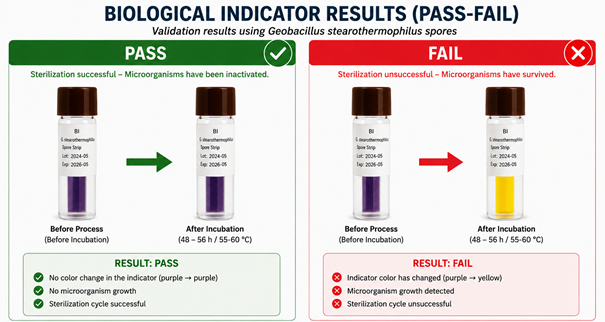
During validation, biological indicators containing Geobacillus stearothermophilus spores are placed at the locations where sterilization is expected to be most difficult.
After the sterilization cycle has been completed, the indicators are incubated. If no spore growth is observed, the sterilization process is considered to have been completed successfully.
Today, this method is regarded as one of the most reliable methods for sterilization validation.
System Features Required for STAATT Level IV
Modern autoclave systems designed to achieve STAATT Level IV performance generally include the following features:
- High-pressure saturated steam system
- Fully automatic PLC control
- Multiple temperature and pressure sensors
- Multi-stage vacuum system
- Vacuum leak testing
- Continuous process recording system
- Design suitable for biological validation
- Data recording infrastructure providing complete traceability
These features ensure that every sterilization cycle can be repeated at the same quality level and recorded in accordance with international standards.
Conclusion
STAATT Level IV is the highest microbial performance criterion defined for alternative medical waste sterilization technologies.
This level does not evaluate only the process temperature or sterilization duration. It also requires scientific proof that the system can inactivate even the most resistant bacterial spores by at least 6 Log₁₀, corresponding to an inactivation rate of 99.9999%.
STAATT Level IV is therefore not merely a technical classification. It is also one of the highest indicators of reliability that sterilization technologies can achieve in terms of patient safety, occupational health, environmental protection, and regulatory compliance.
